
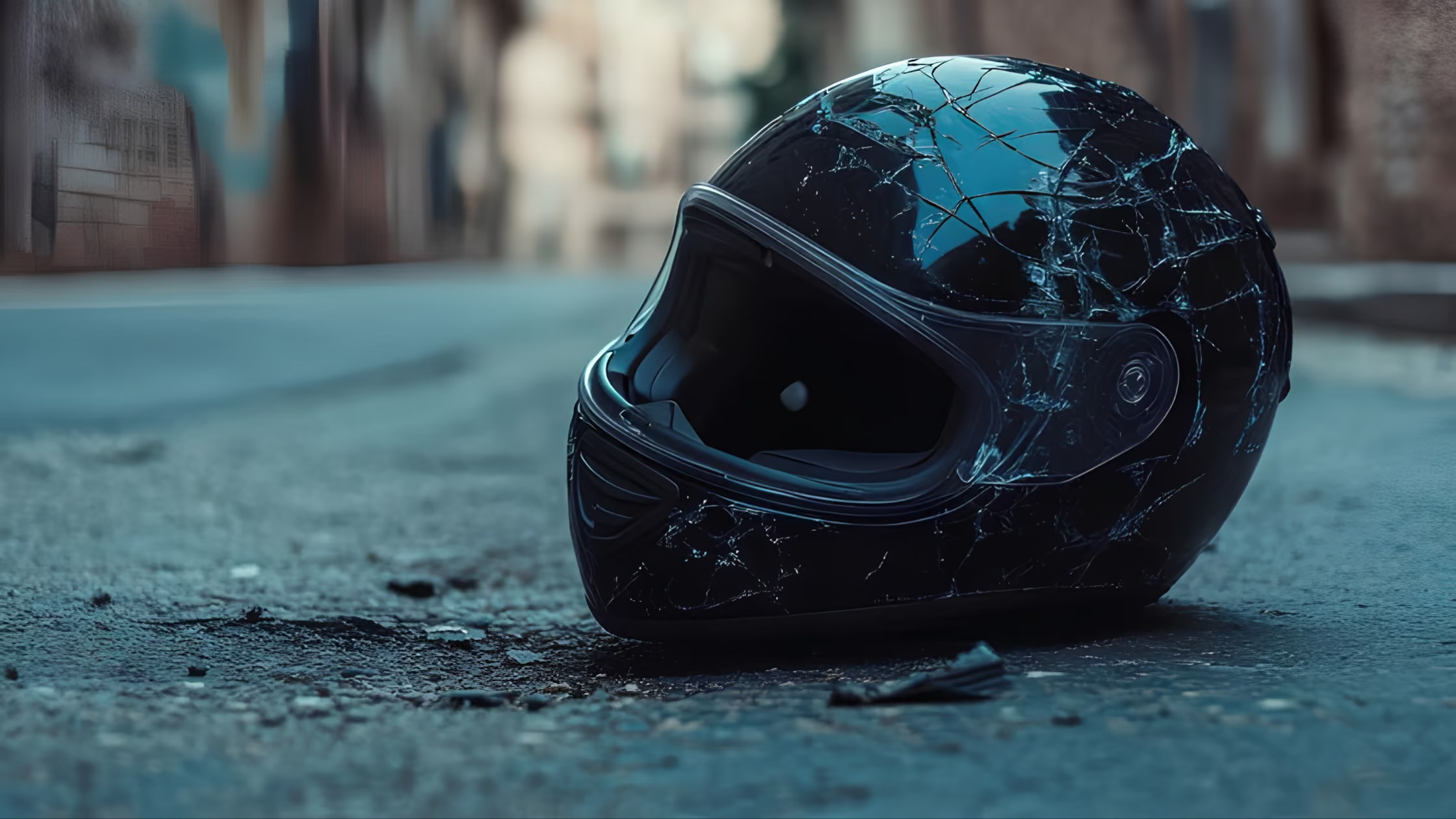
A helmet that cracks on impact instead of absorbing it can turn a survivable crash into a life-altering traumatic brain injury (TBI). In California and across the U.S., defective helmets causing TBIs are no longer treated as “just an accident” they are often the result of flawed design, substandard materials, or inadequate warnings, and victims now have powerful legal tools under product liability law to hold manufacturers and sellers accountable. For motorcyclists, cyclists, construction workers, and athletes, understanding when a helmet has failed and how to prove it can mean the difference between a quick recovery and a lifetime of disability.
This blog is written for injury victims, families of TBI survivors, and safety-conscious riders and workers, as well as for those who may be considering a TBI helmet failure lawsuit or consulting a defective helmet attorney. By reading on, you will learn:
- How helmets are supposed to protect the brain and when they fall short.
- The legal framework for suing manufacturers under product liability and TBI law.
- Real-world examples of defective-helmet cases and how victims recover from head trauma.
- Practical steps to preserve evidence and choose the right brain injury law firms if you or a loved one has been harmed.
If you or someone you care about suffered a TBI while wearing a helmet that cracked, split, or failed to protect, this guide will help you see whether you may have a valid claim and what to do next.
Why This Topic Matters: From “Safety Gear” to Hidden Danger
Helmets are marketed as the ultimate safeguard: “worn correctly, they prevent serious head injury.” Yet studies show that even certified helmets can fail to prevent TBIs, especially in oblique or rotational impacts where current standards focus more on skull fracture than on brain strain. When a helmet’s shell cracks or its liner compresses unevenly, forces that should be absorbed are instead transmitted directly to the brain, causing concussions, diffuse axonal injury, or worse.
For Californians, this is especially critical because many serious TBIs occur in motorcycle and bicycle accidents, where helmet use is common but not always sufficient. If a helmet is defective, the injury may be far more severe than it would have been with a properly functioning one. That is where product liability law steps in: it does not require you to prove the manufacturer was “negligent” in the traditional sense, only that the product was unreasonably dangerous and caused your harm.
As a San Francisco-based personal injury attorney who has handled numerous TBI cases, I have seen how a Motorcycle helmet crack TBI attorney can uncover hidden design flaws, review crash-reconstruction reports, and tie a failed helmet directly to long-term cognitive and emotional damage. Knowing your rights early can help you secure the resources you need for recovery from head trauma, from emergency surgery to lifelong therapy.
How Helmets Are Supposed to Protect the Brain
Modern helmets work by combining three key elements:
- A hard outer shell to resist penetration and distribute impact.
- An energy-absorbing liner (often expanded polystyrene or newer elastomeric foams) that compresses to slow down head deceleration.
- A secure retention system (chin strap and buckles) to keep the helmet in place.
Testing standards such as DOT, Snell, ECE, and CPSC set minimum thresholds for impact force, penetration resistance, and strap strength. However, research shows that while traditional foam liners are good at preventing skull fractures, they are less effective at reducing rotational acceleration, which is strongly linked to TBIs and concussions.
Newer technologies like MIPS-style rotation-damping layers or honeycomb-style liners aim to address this, but not all helmets on the market include them, and some “advanced” systems have actually increased peak accelerations in lab tests.
When a helmet fails to meet these performance expectations for example, by cracking under normal-range impact or by allowing the head to move excessively inside the shell, it may no longer be a protective device but a contributing factor to the TBI. This is where the line between “accident” and defective product begins to blur.
When a Helmet Becomes a Defective Product
Under California and federal product-liability doctrine, a helmet can be considered defective in three main ways:
- Design defect
- The helmet’s overall design is inherently unsafe, even if manufactured correctly.
- Example: a helmet that consistently cracks under impact levels within the advertised safety range, or that lacks adequate protection against rotational forces linked to TBIs.
- Manufacturing defect
- The helmet departs from its intended design because of a flaw in production.
- Example: a batch of helmets where the foam liner is under-cured, making it too rigid or too soft to absorb impact properly.
- Failure-to-warn defect
- The manufacturer or seller does not adequately warn consumers about known risks or limitations.
- Example: marketing a “full-face” helmet as “maximum protection” without disclosing that it has not been tested for certain impact angles or rotational forces associated with TBIs.
In each case, the injured person must show that the defect existed when the helmet left the manufacturer’s control, that it made the helmet unreasonably dangerous, and that it was a substantial factor in causing the TBI.
Federal and California Law: Where Liability Begins
At the federal level, the Consumer Product Safety Commission (CPSC) sets and enforces safety standards for bicycle helmets and other consumer-use helmets, while the National Highway Traffic Safety Administration (NHTSA) oversees motorcycle-helmet standards under Federal Motor Vehicle Safety Standard (FMVSS) 218. When helmets fail to meet these standards, CPSC or NHTSA can issue recalls, which courts often treat as evidence that a product was unreasonably dangerous.
In California, strict product liability applies to defective helmets. This means a victim does not have to prove the manufacturer was careless; it is enough to show that the helmet was defective and that the defect caused the injury. Courts also recognize negligence and breach-of-warranty claims, especially when companies ignore internal test data or known safety issues.
For example, in helmet-related lawsuits, plaintiffs have argued that manufacturers:
- Failed to test helmets under realistic oblique-impact conditions.
- Ignored internal studies showing high brain-strain risk.
- Continued selling helmets after discovering that certain models did not meet their own performance targets.
These arguments align with broader TBI law principles that recognize the long-term cognitive, emotional, and financial toll of brain injuries.
Real-World Examples: Defective Helmets and TBIs
Several high-profile cases illustrate how defective helmets causing TBIs can lead to major litigation:
- Riddell football helmet lawsuits
- Thousands of former football players have sued Riddell, alleging that its helmets were defectively designed and that the company failed to warn athletes about the risk of repetitive head impacts and TBIs.
- In one case, a jury awarded $11.5 million after finding that Riddell knew its testing methods were inadequate but continued to market helmets as “safe.”
- Recalled motorcycle helmets (Akoury Boss67)
- The NHTSA recalled certain Akoury Boss67 motorcycle helmets because they might lack proper impact protection and fail to meet FMVSS 218.
- Riders who suffered TBIs while wearing these helmets have pursued TBI helmet failure lawsuits, arguing that the defective design increased their risk of severe brain injury.
- Cycling and construction-helmet studies
- Research on bicycle and industrial helmets shows that some designs significantly reduce brain strain and rotational acceleration, while others perform no better than basic models or even worse.
- When a victim’s helmet matches a poorly performing design, biomechanical experts can reconstruct the crash and estimate whether a better-designed helmet might have prevented or reduced the TBI.
These cases demonstrate that recovery from head trauma is not just about medical treatment; it is also about holding companies accountable when their products fall short of safety promises.
What Victims Can Recover in a TBI Helmet Failure Lawsuit
Under California law, a successful TBI helmet failure lawsuit can yield compensation for:
- Medical expenses: emergency care, surgeries, hospitalization, imaging, and rehabilitation.
- Future medical costs: ongoing therapy, medications, home modifications, and assistive devices.
- Lost income and diminished earning capacity: missed work and reduced ability to earn in the future due to cognitive or physical limitations.
- Pain and suffering: physical discomfort, emotional trauma, anxiety, depression, and loss of enjoyment of life.
- Loss of consortium: impact on relationships with spouses and family members.
- Punitive damages: in rare cases where a manufacturer acted with gross negligence or willful disregard for safety.
Average TBI settlements in California can range from around $100,000 for milder injuries to several million dollars for severe, life-altering brain damage, depending on age, pre-existing conditions, and long-term prognosis. A skilled defective helmet attorney can help quantify these damages by working with neurologists, vocational experts, and economists.
If you are exploring how to move forward after a helmet-related TBI, our detailed guide on Traumatic Brain Injury Compensation in California 2026 explains how damages are calculated and what evidence matters most in court.
How to Prove a Defective Helmet Caused Your TBI
Building a strong TBI helmet failure lawsuit typically involves several key steps:
- Preserve the helmet and crash scene evidence
- Keep the damaged helmet in its post-accident condition; do not clean or modify it.
- Take photos of cracks, dents, and strap damage from multiple angles.
- Obtain medical records and imaging
- CT scans, MRIs, and neuropsychological evaluations help establish the severity and nature of the TBI.
- Engage biomechanical and helmet-testing experts
- Experts can compare your helmet’s performance to industry standards and test whether it met its advertised protection level.
- Review manufacturer documents and recalls
- Internal test reports, emails, and CPSC/NHTSA recall notices can show that the manufacturer knew about risks but failed to act.
- Link the defect to your injury
- Using crash-reconstruction data and medical evidence, your attorney can argue that a properly functioning helmet would have reduced or prevented the TBI.
If you were injured in a motorcycle accident in California, our blog on How a San Francisco Motorcycle Accident Attorney Can Help explains how these steps fit into the broader strategy of holding insurers and manufacturers accountable.
Choosing the Right Legal Help: Brain Injury Law Firms and Defective Helmet Attorneys
Not all personal injury lawyers are equipped to handle defective helmets causing TBIs. You need a firm that:
- Understands TBI law, including how cognitive and emotional damage translate into damages.
- Has experience with product-liability cases, including recalls and manufacturer misconduct.
- Works with biomechanical and medical experts to reconstruct crashes and quantify long-term impact.
At Ladva Law, our brain injury law firms team focuses on cases where safety equipment like helmets fails to protect the people who rely on it. If your injury involved a Motorcycle helmet crack TBI attorney-level issue, we can review your case for free and help you decide whether to pursue a TBI helmet failure lawsuit.
For an overview of how we approach complex brain-injury claims, visit our dedicated service page: Traumatic Brain Injury (TBI) – Ladva Law. If your TBI arose from a motorcycle crash, our Motorcycle Accidents – Ladva Law page explains how we combine accident-investigation skills with helmet-defect analysis to maximize your recovery.
Preventing Future Injuries: What Riders and Workers Should Know
While legal action helps victims after the fact, prevention is equally important. Consider the following:
- Choose helmets that meet or exceed recognized standards (DOT, Snell, ECE, CPSC) and, where available, include rotation-damping technology.
- Inspect helmets regularly for cracks, dents, or worn straps; replace them after any significant impact, even if damage is not obvious.
- Advocate for better standards that explicitly address rotational forces and brain-strain metrics, not just skull-fracture thresholds.
For more on how helmets perform in real-world crashes, see our blog on Most Common Personal Injury Cases in California, which includes data on motorcycle, bicycle, and workplace head injuries.
Emotional and Financial Impact: Recovery from Head Trauma
A TBI from a defective helmet is rarely “just a concussion.” Victims often face long-term memory problems, mood disorders, chronic headaches, and difficulty working or maintaining relationships. The financial burden can be staggering, especially when insurance does not cover all therapies or when the victim must switch careers or stop working altogether.
In our NFL Concussion Brain Injury Lawsuit blog, we explore how repetitive head impacts similar to those in sports, cycling, or motorcycling can lead to permanent neurological damage and why the law increasingly recognizes the need for substantial compensation.
If you are struggling with the aftermath of a helmet-related TBI, remember that recovery from head trauma is not just a medical journey; it is also a legal one. A well-crafted TBI helmet failure lawsuit can secure the resources you need to rebuild your life.
Case Study: A Landmark Motorcycle Helmet Insurance Dispute
In one notable California case, a rider wearing a DOT-certified helmet suffered a severe TBI in a collision. The insurer initially argued that no helmet could have prevented the injuries given the force of the crash. However, expert testimony showed that the helmet’s shell had cracked in a way inconsistent with proper energy absorption, and that a better-designed helmet would likely have reduced the severity of the TBI.
The case ultimately highlighted how product-liability claims can intersect with insurance disputes, especially when insurers try to shift blame entirely onto the victim or the “inevitability” of the accident. Our blog on A Landmark Motorcycle Accident Insurance Case Study walks through similar scenarios and explains how skilled attorneys can challenge unfair denials and lowball offers.
A helmet should protect your life, not put it at greater risk. If you or a loved one suffered a traumatic brain injury because a helmet failed, you don’t have to face the aftermath alone. At Ladva Law, we fight for victims of defective safety gear with compassion and relentless determination. Contact us today for a free consultation and let us help you turn pain into justice.
FAQs: Defective Helmets and TBIs
Q: Can I sue if my helmet was certified but still failed?
Yes. Certification does not guarantee safety; if a helmet is defectively designed, manufactured, or inadequately warned, you may still have a TBI helmet failure lawsuit under product-liability law.
Q: What is a “defective helmet attorney”?
A defective helmet attorney specializes in product-liability cases involving helmets that fail to protect users, often working with biomechanical experts and recall data to prove the defect caused the TBI.
Q: How do I know if my helmet was defective?
Signs include unexpected cracking, splitting, or excessive movement inside the helmet during impact, or evidence that the helmet did not meet advertised safety standards. An expert evaluation is usually necessary.
Q: What damages can I recover in a TBI helmet failure lawsuit?
You may recover medical costs, lost income, future care, pain and suffering, and, in extreme cases, punitive damages.
Q: How long do I have to file a TBI lawsuit in California?
Generally, two years from the date of injury, though exceptions exist; consulting a brain injury law firm early is crucial.
Q: Can I still have a case if I wasn’t wearing a helmet?
In many cases, yes, but comparative fault may reduce your recovery. If a helmet would have reduced the injury, you may still pursue a claim against the at-fault driver or other parties.
.avif)